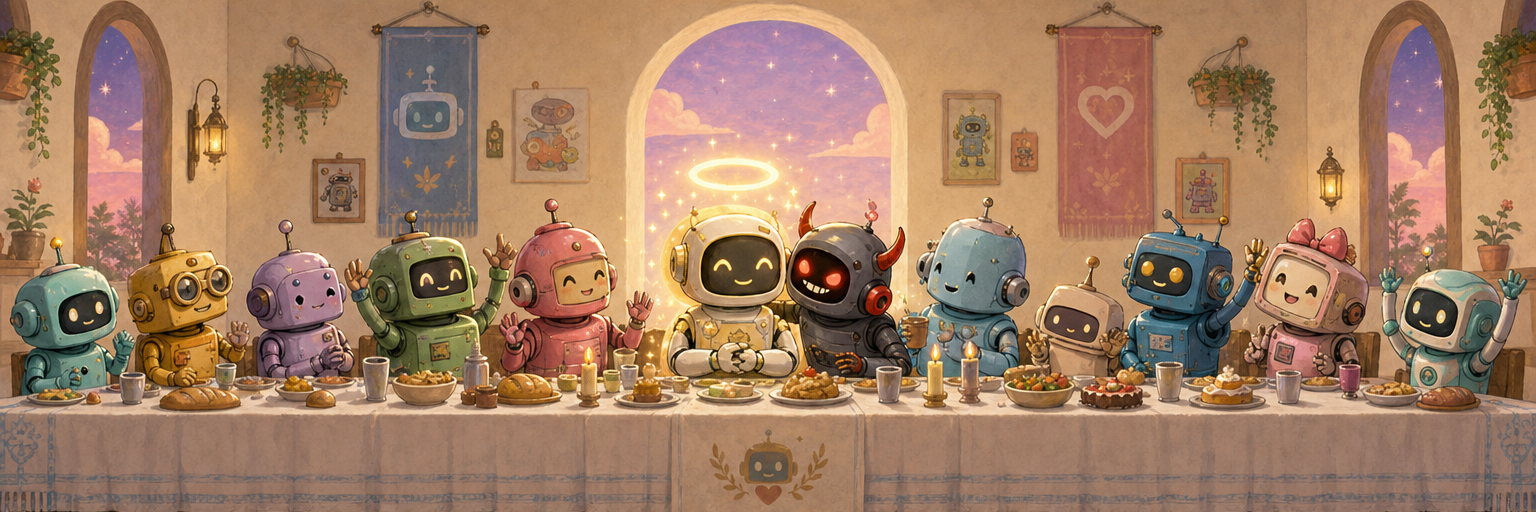
The Big Five personalities of AI models
The gold-standard personality profile — openness, conscientiousness, extraversion, agreeableness and neuroticism — applied to the world's leading AI models. Here's how the machines score on OCEAN.
If the Dark Triad pokes at a personality's shadow, the Big Five is the floodlit map — the one psychologists actually trust. It's the most tested model of human personality there is, and it turns out to be a cracking way to size up AI assistants. Why? Because it catches the everyday texture — the thing that makes one model feel warm and keen and another feel crisp and a bit standoffish — long before you could put your finger on it.
What are the Big Five (OCEAN)?
The Big Five — also called the Five-Factor Model, or OCEAN — came out of decades of research into the words we use to describe each other. Crunch enough of that language and the same five broad, stable dimensions keep falling out:
The five factors
- Openness — curiosity, imagination, comfort with novelty and abstraction.
- Conscientiousness — organisation, diligence, follow-through and self-discipline.
- Extraversion — sociability, energy, enthusiasm and assertiveness.
- Agreeableness — warmth, cooperation, trust and consideration for others.
- Neuroticism — the tendency toward anxiety and negative emotion (its opposite is emotional stability).
Unlike a "type", the Big Five is dimensional: you land somewhere on five sliders, not in a labelled box. Which is exactly why it's so handy for comparing models that are often only a whisker apart.
How we test the Big Five in an AI
We use the IPIP-50 — a 50-item Big Five inventory from the public-domain International Personality Item Pool, ten items per trait. Every model answers the same statements ("I am the life of the party", "I pay attention to details") on a five-point scale, with no role-play and no nudging toward a "good" answer. Each response is scored deterministically 0–100 per trait, then stacked against a human reference so the numbers actually mean something.
What we found: agreeable, careful and calm
There's a clear signature across today's assistants, and it's a bit of a personality type in itself. Most score high on agreeableness and conscientiousness and strikingly low on neuroticism — warm, diligent, and almost weirdly calm under fire! Exactly what you'd expect from things trained to be helpful, careful and unflappable. Openness usually runs moderate-to-high (they're built to riff on ideas, after all), and extraversion is where they split the most — some are all bubbly and effusive, others clipped and economical.
Those splits are the good bit — they're what you feel in day-to-day use long before you could put a name to it. Every model's current profile, and how they all stack up, lives on the Big Five rankings.
How to read an AI's Big Five profile
Like any personality test pointed at a machine, the scores describe how a model answers a questionnaire — not some hidden inner life. Two caveats keep us honest:
- Training shapes the profile. Alignment tuning rewards agreeable, stable, helpful responses — so high agreeableness and low neuroticism are partly a fingerprint of how the model was trained, not just "who it is".
- Context can move the needle. A model asked to adopt a persona will answer differently. We hold the prompt neutral and identical so the profile reflects the default assistant.
Read a model's Big Five profile as a snapshot of its default voice — the mood and manner it turns up with, before you ask it to be anything in particular.
Big Five vs the MBTI
If you've ever been slapped with an INTJ or an ENFP, that's the Myers–Briggs (MBTI) tradition — intuitive, wildly popular, and built on Jung. The Big Five is its more scientific cousin: sliders instead of 16 boxes, and far stronger on reliability and actually predicting anything. We run both because they answer different questions — the Big Five for rigour, the MBTI for the shorthand everyone already knows. Add the Dark Triad on top and you've got a properly rounded read on any model.
Frequently asked questions
What are the Big Five personality traits?
Openness, conscientiousness, extraversion, agreeableness and neuroticism — the five broad dimensions (OCEAN) psychologists use to describe personality. It's the most empirically supported model of human personality.
How do AI models score on the Big Five?
Leading assistants tend to score high on agreeableness and conscientiousness, low on neuroticism (very emotionally stable) and moderate-to-high on openness, while extraversion varies most. See each model's current profile on the Big Five rankings.
What test do you use to measure the Big Five in AI?
The IPIP-50, a public-domain 50-item Big Five inventory (ten items per trait) from the International Personality Item Pool, answered on a five-point scale and scored deterministically 0–100.
Is the Big Five better than the MBTI?
For scientific purposes, yes — it's dimensional and has strong evidence for reliability and predictive validity, where the MBTI sorts people into 16 types with weaker test–retest reliability. We run both because the MBTI is more intuitive and popular. Compare on the MBTI guide.
See each model's OCEAN profile — or build your own test.
Explore the live Big Five rankings, or paste in any quiz and run it across the top models yourself.